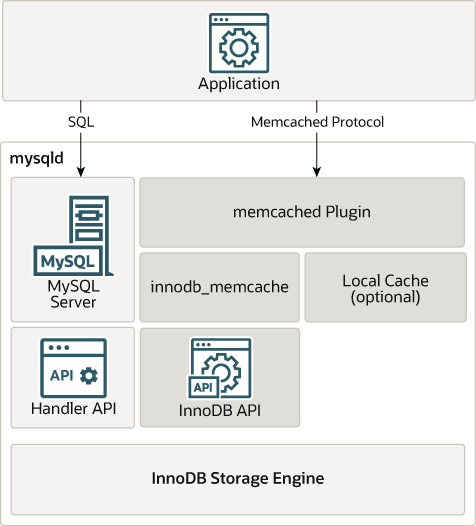
This section describes how the memcached daemon is integrated into the MySQL Server, to help understand how this approach compares with other techniques that combine NoSQL components or interfaces with a MySQL back-end.
When integrated with MySQL Server, memcached is
implemented as a MySQL plugin daemon, accessing the
InnoDB storage engine directly and bypassing
the SQL layer:
Features provided in the current release:
memcached as a daemon plugin of mysqld: both mysqld and memcached run in the same process space, with very low latency access to data.
Direct access to InnoDB tables, bypassing
the SQL parser, the optimizer, and even the Handler API layer.
Standard memcached protocols, both the
text-based protocol and the binary protocol. The
InnoDB + memcached
combination passes all 55 compatibility tests from the
memcapable command.
Multi-column support: you can map multiple columns into the “value” part of the key/value store, with column values delimited by a user-specified separator character.
By default, you use the memcached protocol
to read and write data directly to InnoDB,
and let MySQL manage the in-memory caching through the
InnoDB
buffer pool.
The default settings represent the combination of high
reliability with the fewest surprises for database
applications. For example, the default settings avoid
uncommitted data on the database side, or stale data returned
for memcached get
requests.
You can control how often data is passed back and forth
between InnoDB and memcached operations
through the
innodb_api_bk_commit_interval,
daemon_memcached_r_batch_size,
and
daemon_memcached_w_batch_size
configuration options. Both the batch size options default to
a value of 1 for maximum reliability.
You can specify any memcached configuration
options through the MySQL configuration variable
daemon_memcached_option. For
example, you might change the port that
memcached listens on, reduce the maximum
number of simultaneous connections, change the maximum memory
size for a key/value pair, or enable debugging messages for
the error log.
A configuration option
innodb_api_trx_level lets you
control the transaction
isolation level on
queries processed by the memcached
interface. Although memcached has concept
of transactions, you
might use this property to control how soon
memcached sees changes caused by SQL
statements, if you issue DML
statements on the same table that memcached
interfaces with. By default, it is set to
READ UNCOMMITTED.
Another configuration option is
innodb_api_enable_mdl.
“MDL” stands for “metadata locking”.
This basically locks the table from the MySQL level, so that
the mapped table cannot be dropped or altered by
DDL through the SQL interface.
Without the lock, the table can be dropped from MySQL layer,
but will be kept in the InnoDB storage until
memcached or any other user stops using it.
InnoDB
MySQL users might already be familiar with using
memcached along with MySQL, as described in
Section 15.6, “Using MySQL with memcached”. This section describes the
similarities and differences between the information in that
section, and when using the InnoDB integration
features of the memcached that is built into
MySQL. The link at the start of each item goes to the associated
information about the traditional memcached
server.
Installation:
Because the memcached library comes with
the MySQL server, installation and setup are straightforward.
You run a SQL script to set up a table for
memcached to use, issue a one-time
install plugin statement to enable
memcached, and add to the MySQL
configuration file or startup script any desired
memcached options, for example to use a
different port. You might still install the regular
memcached distribution to get the
additional utilities such as memcp,
memcat, and memcapable.
Deployment:
It is typical to run large numbers of low-capacity
memcached servers. Because the
InnoDB + memcached
combination has a 1:1 ratio between database and
memcached servers, the typical deployment
involves a smaller number of moderate or high-powered servers,
machines that were already running MySQL. The benefit of this
server configuration is more for improving the efficiency of
each individual database server than in tapping into unused
memory or distributing lookups across large numbers of
servers. In the default configuration, very little memory is
used for memcached, and the in-memory
lookups are served from the InnoDB
buffer pool, which
automatically caches the most recently used and most
frequently used data. As in a traditional MySQL server
instance, keep the value of the
innodb_buffer_pool_size
configuration option as high as practical (without causing
paging at the OS level), so that as much of the workload as
possible is done in memory.
Expiry: By
default (that is, with the caching policy
innodb_only), the latest data from the
InnoDB table is always returned, so the
expiry options have no practical effect. If you change the
caching policy to caching or
cache-only, the expiry options work as
usual, but requested data might be stale if it was updated in
the underlying table before it expires from the memory cache.
Namespaces:
memcached is like a single giant directory,
where to keep files from conflicting with each other you might
give them elaborate names with prefixes and suffixes. The
integrated InnoDB /
memcached server lets you use these same
naming conventions for keys, with one addition. Key names of
the format
@@.table_id.keytable_id
are decoded to reference a specific a table, using mapping
data from the innodb_memcache.containers
table. The key is looked up in or
written to the specified table.
The @@ notation only works for individual
calls to the get, add,
and set functions, not the others such as
incr or delete. To
designate the default table for all subsequent
memcached operations within a session,
perform a get request using the
@@ notation and a table ID, but without the
key portion. For example:
get @@table_x
Subsequent get, set,
incr, delete and other
operations use the table designated by
table_x in the
innodb_memcache.containers.name column.
Hashing and
distribution: The default configuration, with the
caching policy innodb_only, is suitable for
the traditional deployment configuration where all data is
available on all servers, such as a set of replication slave
servers.
If you physically divide the data, as in a sharded
configuration, you can split the data across several machines
running the InnoDB and
memcached combined server, and use the
traditional memcached hashing mechanism to
route requests to a particular machine. On the MySQL side,
typically you would let all the data be inserted by
add requests to
memcached so the appropriate values were
stored in the database on the appropriate server.
These types of deployment best practices are still being codified.
Memory usage:
By default (with the caching policy
innodb_only), the
memcached protocol passes information back
and forth with InnoDB tables, and the
fixed-size InnoDB buffer pool handles the
in-memory lookups rather than memcached
memory usage growing and shrinking. Relatively little memory
is used on the memcached side.
If you switch the caching policy to caching
or cache-only, the normal rules of
memcached memory usage apply. Memory for
the memcached data values is allocated in
terms of “slabs”. You can control the slab size
and maximum memory used for memcached.
Either way, you can monitor and troubleshoot the integrated
memcached daemon using the familiar
statistics system,
accessed through the standard protocol, for example over a
telnet session. Because extra utilities are
not included with the integrated daemon, to use the
memcached-tool
script, install a full memcached
distribution.
Thread usage: MySQL threads and memcached threads must co-exist on the same server, so any limits imposed on threads by the operating system apply to this total number.
Log usage:
Because the memcached daemon is run
alongside the MySQL server and writes to
stderr, the -v,
-vv, and -vvv options
for logging write their output to the MySQL
error log.
memcached
operations: All the familiar operations such as
get, set,
add, and delete are
available. Serialization (that is, the exact string format to
represent complex data structures) depends on the language
interface. Still to confirm if there are any special nuances
for these operations:
delete(key, [, time]): Deletes the key and its associated item from the cache. If you supply a time, then adding another item with the specified key is blocked for the specified period. flush_all: Invalidates (or expires) all the current items in the cache. Technically they still exist (they are not deleted), but they are silently destroyed the next time you try to access them.
Using
memcached as a MySQL front end: That
is what the InnoDB integration with
memcached is all about. Putting these
components together improves the performance of your
application. Making InnoDB handle data
transfers between memory and disk simplifies the logic of your
application.
Utilities:
The MySQL server includes the libmemcached
library but not the additional command-line utilities. To get
the commands such as memcp,
memcat, and memcapable
commands, install a full memcached
distribution. When memrm and
memflush remove items from the cache, they
are also removed from the underlying InnoDB
table.
Programming
interfaces: You can access the MySQL server through the
InnoDB and memcached
combination using the same language as always:
C and
C++,
Java,
Perl,
Python,
PHP, and
Ruby.
Specify the server hostname and port as with any other
memcached server. By default, the
integrated memcached server listens on the
same port as usual, 11211. You can use both
the text and
binary protocols. You can customize the
behavior
of the memcached functions at runtime.
Serialization (that is, the exact string format to represent
complex data structures) depends on the language interface.
Frequently asked
questions: MySQL has had an extensive
memcached FAQ for several releases. In
MySQL 5.6, the answers are largely the same,
except that using InnoDB tables as a
storage medium for memcached data means
that you can use this combination for more write-intensive
applications than before, rather than as a read-only cache.
For a more detailed look at the workings of this feature, see Section 14.2.9.7, “Internals of the InnoDB memcached Plugin”.

User Comments
Add your own comment.