MySQL 9.7 Release Notes
This section discusses known problems or issues when using replication with NDB Cluster.
Loss of connection between source and replica.
A loss of connection can occur either between the source cluster
SQL node and the replica cluster SQL node, or between the source
SQL node and the data nodes of the source cluster. In the latter
case, this can occur not only as a result of loss of physical
connection (for example, a broken network cable), but due to the
overflow of data node event buffers; if the SQL node is too slow
to respond, it may be dropped by the cluster (this is
controllable to some degree by adjusting the
MaxBufferedEpochs and
TimeBetweenEpochs
configuration parameters). If this occurs, it is
entirely possible for new data to be inserted into the source
cluster without being recorded in the source SQL node's
binary log. For this reason, to guarantee high
availability, it is extremely important to maintain a backup
replication channel, to monitor the primary channel, and to fail
over to the secondary replication channel when necessary to keep
the replica cluster synchronized with the source. NDB Cluster is
not designed to perform such monitoring on its own; for this, an
external application is required.
The source SQL node issues a “gap” event when
connecting or reconnecting to the source cluster. (A gap event is
a type of “incident event,” which indicates an
incident that occurs that affects the contents of the database but
that cannot easily be represented as a set of changes. Examples of
incidents are server failures, database resynchronization, some
software updates, and some hardware changes.) When the replica
encounters a gap in the replication log, it stops with an error
message. This message is available in the output of
SHOW REPLICA STATUS, and indicates
that the SQL thread has stopped due to an incident registered in
the replication stream, and that manual intervention is required.
See Section 25.7.8, “Implementing Failover with NDB Cluster Replication”, for more
information about what to do in such circumstances.
Important
Because NDB Cluster is not designed on its own to monitor replication status or provide failover, if high availability is a requirement for the replica server or cluster, then you must set up multiple replication lines, monitor the source mysqld on the primary replication line, and be prepared fail over to a secondary line if and as necessary. This must be done manually, or possibly by means of a third-party application. For information about implementing this type of setup, see Section 25.7.7, “Using Two Replication Channels for NDB Cluster Replication”, and Section 25.7.8, “Implementing Failover with NDB Cluster Replication”.
If you are replicating from a standalone MySQL server to an NDB Cluster, one channel is usually sufficient.
Circular replication. NDB Cluster Replication supports circular replication, as shown in the next example. The replication setup involves three NDB Clusters numbered 1, 2, and 3, in which Cluster 1 acts as the replication source for Cluster 2, Cluster 2 acts as the source for Cluster 3, and Cluster 3 acts as the source for Cluster 1, thus completing the circle. Each NDB Cluster has two SQL nodes, with SQL nodes A and B belonging to Cluster 1, SQL nodes C and D belonging to Cluster 2, and SQL nodes E and F belonging to Cluster 3.
Circular replication using these clusters is supported as long as the following conditions are met:
The SQL nodes on all source and replica clusters are the same.
All SQL nodes acting as sources and replicas are started with the system variable
log_replica_updatesenabled.
This type of circular replication setup is shown in the following diagram:
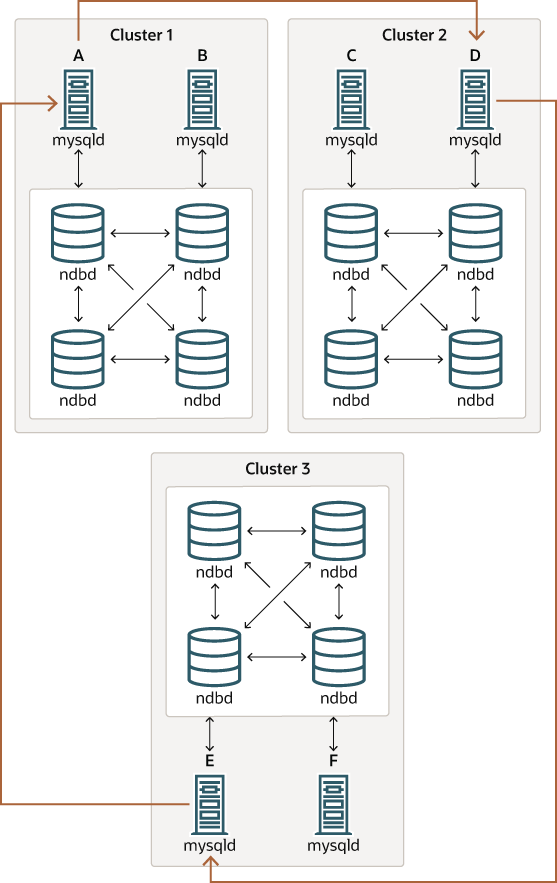
In this scenario, SQL node A in Cluster 1 replicates to SQL node C in Cluster 2; SQL node C replicates to SQL node E in Cluster 3; SQL node E replicates to SQL node A. In other words, the replication line (indicated by the curved arrows in the diagram) directly connects all SQL nodes used as sources and replicas.
It should also be possible to set up circular replication in which not all source SQL nodes are also replicas, as shown here:
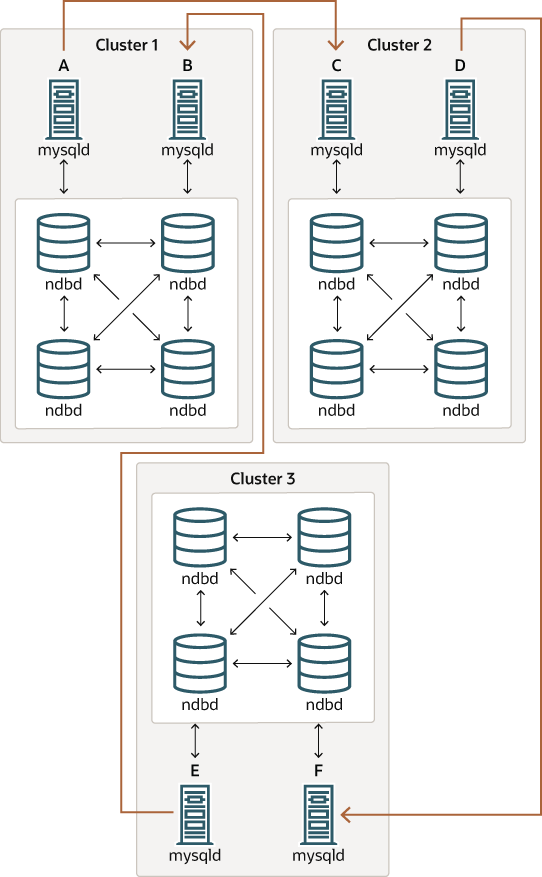
In this case, different SQL nodes in each cluster are used as
sources and replicas. However, you must not
start any of the SQL nodes with the
log_replica_updates system
variable enabled. This type of circular replication scheme for NDB
Cluster, in which the line of replication (again indicated by the
curved arrows in the diagram) is discontinuous, should be
possible, but it should be noted that it has not yet been
thoroughly tested and must therefore still be considered
experimental.
Note
The NDB storage engine uses
idempotent execution mode,
which suppresses duplicate-key and other errors that otherwise
break circular replication of NDB Cluster. This is equivalent to
setting the global value of the system variable
replica_exec_mode to
IDEMPOTENT, although this is not necessary in
NDB Cluster replication, since NDB Cluster sets this variable
automatically and ignores any attempts to set it explicitly.
NDB Cluster replication and primary keys.
In the event of a node failure, errors in replication of
NDB tables without primary keys can
still occur, due to the possibility of duplicate rows being
inserted in such cases. For this reason, it is highly
recommended that all NDB tables
being replicated have explicit primary keys.
NDB Cluster Replication and Unique Keys.
In older versions of NDB Cluster, operations that updated values
of unique key columns of NDB tables
could result in duplicate-key errors when replicated. This issue
is solved for replication between
NDB tables by deferring unique key
checks until after all table row updates have been performed.
Deferring constraints in this way is currently supported only by
NDB. Thus, updates of unique keys
when replicating from NDB to a
different storage engine such as
InnoDB or
MyISAM are still not supported.
The problem encountered when replicating without deferred checking
of unique key updates can be illustrated using
NDB table such as
t, is created and populated on the source (and
transmitted to a replica that does not support deferred unique key
updates) as shown here:
CREATE TABLE t (
    p INT PRIMARY KEY,
    c INT,
    UNIQUE KEY u (c)
)   ENGINE NDB;

INSERT INTO t
    VALUES (1,1), (2,2), (3,3), (4,4), (5,5);
The following UPDATE statement on
t succeeds on the source, since the rows
affected are processed in the order determined by the
ORDER BY option, performed over the entire
table:
UPDATE t SET c = c - 1 ORDER BY p;The same statement fails with a duplicate key error or other constraint violation on the replica, because the ordering of the row updates is performed for one partition at a time, rather than for the table as a whole.
Note
Every NDB table is implicitly
partitioned by key when it is created. See
Section 26.2.5, “KEY Partitioning”, for more information.
GTIDs not supported.
Replication using global transaction IDs is not compatible with
the NDB storage engine, and is not supported.
Enabling GTIDs is likely to cause NDB Cluster Replication to
fail.
Restarting with --initial.
Restarting the cluster with the
--initial option causes the
sequence of GCI and epoch numbers to start over from
0. (This is generally true of NDB Cluster and
not limited to replication scenarios involving Cluster.) The
MySQL servers involved in replication should in this case be
restarted. After this, you should use the
RESET BINARY LOGS AND GTIDS and
RESET REPLICA statements to clear
the invalid ndb_binlog_index and
ndb_apply_status tables, respectively.
Replication from NDB to other storage engines.
It is possible to replicate an NDB
table on the source to a table using a different storage engine
on the replica, taking into account the restrictions listed
here:
Multi-source and circular replication are not supported (tables on both the source and the replica must use the
NDBstorage engine for this to work).Using a storage engine which does not perform binary logging for tables on the replica requires special handling.
Use of a nontransactional storage engine for tables on the replica also requires special handling.
The source mysqld must be started with
--ndb-log-update-as-write=0or--ndb-log-update-as-write=OFF.
The next few paragraphs provide additional information about each of the issues just described.
Multiple sources not supported when replicating NDB to other storage
engines.
For replication from NDB to a
different storage engine, the relationship between the two
databases must be one-to-one. This means that bidirectional or
circular replication is not supported between NDB Cluster and
other storage engines.
In addition, it is not possible to configure more than one
replication channel when replicating between
NDB and a different storage engine.
(An NDB Cluster database can simultaneously
replicate to multiple NDB Cluster databases.) If the source uses
NDB tables, it is still possible to
have more than one MySQL Server maintain a binary log of all
changes, but for the replica to change sources (fail over), the
new source-replica relationship must be explicitly defined on the
replica.
Replicating NDB tables to a storage engine that does not perform binary logging. If you attempt to replicate from an NDB Cluster to a replica that uses a storage engine that does not handle its own binary logging, the replication process aborts with the error Binary logging not possible ... Statement cannot be written atomically since more than one engine involved and at least one engine is self-logging (Error 1595). It is possible to work around this issue in one of the following ways:
Turn off binary logging on the replica. This can be accomplished by setting
sql_log_bin = 0.Change the storage engine used for the mysql.ndb_apply_status table. Causing this table to use an engine that does not handle its own binary logging can also eliminate the conflict. This can be done by issuing a statement such as
ALTER TABLE
            mysql.ndb_apply_status ENGINE=MyISAM
on the replica. It is safe to do this when using a storage engine other thanNDBon the replica, since you do not need to worry about keeping multiple replicas synchronized.Filter out changes to the mysql.ndb_apply_status table on the replica. This can be done by starting the replica with
--replicate-ignore-table=mysql.ndb_apply_status. If you need for other tables to be ignored by replication, you might wish to use an appropriate--replicate-wild-ignore-tableoption instead.
Important
You should not disable replication or
binary logging of mysql.ndb_apply_status or
change the storage engine used for this table when replicating
from one NDB Cluster to another. See
Replication and binary log filtering rules with replication between NDB
Clusters,
for details.
Replication from NDB to a nontransactional storage engine.
When replicating from NDB to a
nontransactional storage engine such as
MyISAM, you may encounter
unnecessary duplicate key errors when replicating
INSERT ...
        ON DUPLICATE KEY UPDATE
statements. You can suppress
these by using
--ndb-log-update-as-write=0,
which forces updates to be logged as writes, rather than as
updates.
NDB Replication and File System Encryption (TDE). The use of an encrypted filesystem does not have any effect on NDB Replication. All of the following scenarios are supported:
Replication of an NDB Cluster having an encrypted file system to an NDB Cluster whose file system is not encrypted.
Replication of an NDB Cluster whose file system is not encrypted to an NDB Cluster whose file system is encrypted.
Replication of an NDB Cluster whose file system is encrypted to a standalone MySQL server using
InnoDBtables which are not encrypted.Replication of an NDB Cluster with an unencrypted file system to a standalone MySQL server using
InnoDBtables with file sytem encryption.
Replication and binary log filtering rules with replication between NDB
Clusters.
If you are using any of the options
--replicate-do-*,
--replicate-ignore-*,
--binlog-do-db, or
--binlog-ignore-db to filter
databases or tables being replicated, you must take care not to
block replication or binary logging of the
mysql.ndb_apply_status, which is required for
replication between NDB Clusters to operate properly. In
particular, you must keep in mind the following:
Using
--replicate-do-db=(and no otherdb_name--replicate-do-*or--replicate-ignore-*options) means that only tables in databasedb_nameare replicated. In this case, you should also use--replicate-do-db=mysql,--binlog-do-db=mysql, or--replicate-do-table=mysql.ndb_apply_statusto ensure thatmysql.ndb_apply_statusis populated on replicas.Using
--binlog-do-db=(and no otherdb_name--binlog-do-dboptions) means that changes only to tables in databasedb_nameare written to the binary log. In this case, you should also use--replicate-do-db=mysql,--binlog-do-db=mysql, or--replicate-do-table=mysql.ndb_apply_statusto ensure thatmysql.ndb_apply_statusis populated on replicas.Using
--replicate-ignore-db=mysqlmeans that no tables in themysqldatabase are replicated. In this case, you should also use--replicate-do-table=mysql.ndb_apply_statusto ensure thatmysql.ndb_apply_statusis replicated.Using
--binlog-ignore-db=mysqlmeans that no changes to tables in themysqldatabase are written to the binary log. In this case, you should also use--replicate-do-table=mysql.ndb_apply_statusto ensure thatmysql.ndb_apply_statusis replicated.
You should also remember that each replication rule requires the following:
Its own
--replicate-do-*or--replicate-ignore-*option, and that multiple rules cannot be expressed in a single replication filtering option. For information about these rules, see Section 19.1.6, “Replication and Binary Logging Options and Variables”.Its own
--binlog-do-dbor--binlog-ignore-dboption, and that multiple rules cannot be expressed in a single binary log filtering option. For information about these rules, see Section 7.4.4, “The Binary Log”.
If you are replicating an NDB Cluster to a replica that uses a
storage engine other than NDB, the
considerations just given previously may not apply, as discussed
elsewhere in this section.
NDB Cluster Replication and IPv6. All types of NDB Cluster nodes support IPv6 in NDB 9.7; this includes management nodes, data nodes, and API or SQL nodes.
Note
In NDB 9.7, you can disable IPv6 support in the Linux kernel if you do not intend to use IPv6 addressing for any NDB Cluster nodes.
Attribute promotion and demotion.
NDB Cluster Replication includes support for attribute promotion
and demotion. The implementation of the latter distinguishes
between lossy and non-lossy type conversions, and their use on
the replica can be controlled by setting the global value of the
system variable
replica_type_conversions.
For more information about attribute promotion and demotion in NDB Cluster, see Row-based replication: attribute promotion and demotion.
NDB, unlike InnoDB
or MyISAM, does not write changes to
virtual columns to the binary log; however, this has no
detrimental effects on NDB Cluster Replication or replication
between NDB and other storage engines. Changes
to stored generated columns are logged.